Thursday, 7 May 2009

Just Admit Your Pathetic Lethargy Lee

Hello!

At the small chance there is anyone out there, as is clear, this site hasn’t been updated in a good three months, alas a final year dissertation and several essays got in the way of me being able to dedicate spare time to much else.

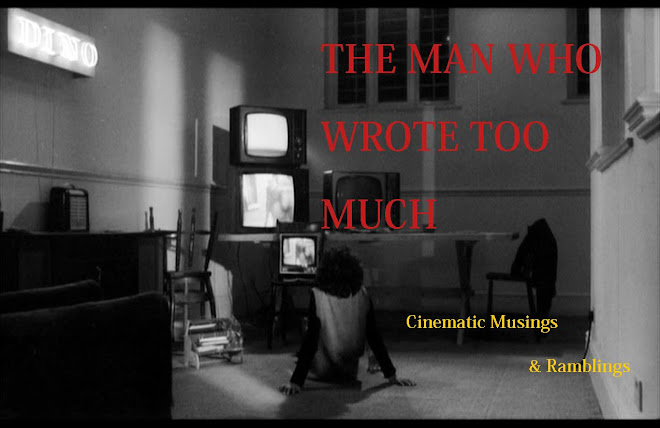
Thankfully said work is now out of the way and I’ve finished my film degree! Rejoice! And I intend on returning to this blog with many more reviews in the next few weeks, until the first reviews begin to appear I shall attempt to appease you with a still from the film that inspired the name of this blog.

Super cool Lorre stylee!

Cheers
Lee

Tuesday, 3 February 2009

Escape From Hong Kong Island (Mak Dau Sin Sang) - Simon Lui - 2004

A little known satirical comedy from China, Escape From Hong Kong Island follows a ruinous day in the life of Hong Kong stock market trader Raymond Mak (Jordan Chan), a despicably cruel hearted yuppie who arrives at work to find that he has been fired as his colleagues can no longer bear to work with him. He arranges another job with a rival firm that is his as long as he makes it to their offices for 5pm that day to sign the contract. This rival company’s office happens to be across the bay in Kowloon. What should be a simple trip across the harbour turns into a catalogue of disasters as he is mugged of his cash and identity and struggles to acquire the money he needs to make it across. Will he make it in time? And more importantly, will he learn a valuable life lesson along the way? (I can’t believe I just wrote that...)


Most of the humour in the film derives from the fact that our character has such a simple task that he cannot complete, all he needs is a few dollars to make it across yet his crippling character fallacies prove to cause him countless problems in even acquiring this minute amount of cash. Jordan Chan succeeds in making Raymond a seemingly irredeemably cold hearted bastard. This is a man who upon finding out that his mother (whom he hasn’t seen in years) is virtually a vegetable after suffering debilitating Alzheimer’s disease, is only concerned as to whether she left any change lying around for him to steal.


The film also succeeds in its broad satirical stabs at post colonial Hong Kong life, we are presented with a hyper modern westernised city suffering the worst excesses of dog eat dog capitalism, where vacuous materialism is the key to social acceptability and friendships are based purely on what can be financially gained from such acquaintances. The film makes clear the ever widening gap between the Island’s Dom Perignon quaffing, $200 lunch eating elite and the underclass of 6 to a room squalor. Raymond also sees himself constantly held up by the frustrating petty bureaucracies of state officialdom and the absurd red tape and rule systems of corporate holdings.

Unfortunately the look of the film sometimes comes across as rather cheap, as director Simon Lui chose the make the film on low quality DV, and pays for it with that classic washed out look leaving all white background images to suffer from retina scaring flashes of blinding light.


Also as the film proceeds you get the uncomfortable feeling that the film will eventually give in to saccharine melodrama, and the last ten minutes does indeed allow the worst excesses of Hollywoodised ‘life lessons’ and A Christmas Carol esq moral redemption to come into play. Also its representation of the neon swirl of the contemporary Hong Kong metropolis pales when placed next to something like Christopher Doyle’s stunning work on Wong-Kar Wai’s Chungking Express (1994).

Still though for the first 80 odd minutes this makes for an entertaining slice of classic shadenfreude, and is well worth an evening’s entertainment.

Saturday, 24 January 2009

Crash - David Cronenberg - 1996

David Cronenberg adapting the work of J.G. Ballard was always a combination that made a lot of sense. If you look at Cronenberg’s debut Shivers (1975), the similarities between that and the same years High-Rise by Ballard are unmistakable. Thematically they both choose to represent technology as the next logical step in human evolution, often presenting worlds where the human body morphs with machinery in a transgressive creation of a ‘new flesh’. A world where sexuality is usually represented as a bourgeois bating series of perversions and is censor worryingly often presented as a consistent partner to violence. Therefore it goes without saying that Crash will unsettle many viewers, and it did of course suffer a campaign of attempted censorship in the UK by that bastion of wholesome goodness and righteous indignation that is the hateful rag The Daily Mail.


The film follows one James Ballard (played by everyone’s favourite cinematic sexual deviant Mr. James Spader) as he and his wife Catherine (Deborah Kara Unger carrying the look of a haunted femme fatale accidentally transported into the 1990’s) find that their sexual relationship has descended into an emotionless series of extramarital affairs, tales of which they regale each other with in an attempt to bring some excitement back into their relationship. This world is changed when James is involved in a major car crash, in which the husband of Dr. Helen Remington (an unusual casting for Holly Hunter) is killed. James forms a tentative relationship with Remington which sees them becoming increasingly involved with a car crash fetishist cult led by Vaughan (The much underused Elias Koteas, making the most of his opportunity to bring a wild eyed fervour to the film).


Whilst there was every chance that the film could have turned into a sex ‘n’ pyrotechnics exploitomess, in the more than capable hands of David Cronenberg it becomes a captivating study of modern day disinterest and isolationism. The decision to relocate the film from the novel’s original setting of the motorways surrounding London’s Heathrow airport to the nondescript freeways and underpasses of Cronenberg’s hometown Toronto proves to be an inspired one. The film feels like it is taking place nowhere and everywhere, as I mentioned in my recent review of Radio On (1979), the car can prove to be a perfect site for examining technology as self imposed segregation. There are no open freeways here, just the busy soul destroying gridlock of inner city travel. We often see the city viewed from the Ballard’s high rise apartment, a vista of grey tower blocks separated into grids by interchanges and intersections.

Cronenberg also takes the decision to leave the characters as largely emotionless blank surfaces, this purposely leaves the viewer with little to connect to, we never find out the reasons for the malaise of the characters or why they find themselves sexually drawn to the body destroying viscera of the car crash. It is this refusal to demonise or even attempt to rationalise their actions that often brings about uncomfortable feelings in the viewer, especially in the case of Catherine, who due to lack of exposition on her characters part, makes her compliance in some of the more forcefully sexual scenes somewhat ambiguous.


Anyone complaining about the films lack of character driven depth would be missing the point though. The refusal to elucidate any plot points is due to the films preoccupation with surfaces, from the metallic sheen of a showroom Mercedes, to the car part tattoos that James and Vaughan chose to cover their bodies with. The only interior Cronenberg is ever concerned with here is that of the body violated, a thematic concern seen throughout his entire oeuvre from the low budget head explosions of Scanners (1981) to the body as site of disintegration and decay seen in the relatively big budget reworking of The Fly (1986). Here we see it as evident as ever, most infamously in the provocative scene featuring a sexual liaison between Patricia Arquette’s Gabrielle (a perfect physical embodiment of the man/machine transgression) and James, in which her leg scars are put to... interesting... use... Though it should be noted that the films risqué subject matter does prove to be more restrained and suggestive than the more sensationalist types would have you believe.

Ballard’s warped increasingly retro-futurist visions found their perfect outlet in Cronenberg’s odd simulacra of existential modernity, in a fascinating film that is all style, no substance, and all the better for it. A fine addition to the Cronenberg canon.
Thursday, 15 January 2009

Woodstock - Michael Wadleigh - 1970

To pigeonhole Michael Wadleigh’s Woodstock as merely a ‘concert film’ would be to do it a great disservice. The documentary only spends around 40% of its running time showing some of the acts playing at the festival, the other 60% devoted to capturing the atmosphere and attendees of this return ‘to the garden’. The film as viewed from a perspective of almost 40 years after the fact, acts as an insightful time capsule into the fears, exigencies and aspirations of a supposedly sanguine generation whom have taken on a mythos of misinterpreted romanticised conjecture as the years have passed.

As we see the festival organisers and attendees spout their peace will out rhetoric, as well as the humour now evident in their naivety of a music festival as statement of cultural rebellion, there is a sense of melancholy in seeing all this hope and righteousness that would soon waste away (head down to Haight-Ashbury in San Francisco today to see the crushingly gentrified and strung out remnants of the scene).


If all the legends were believed, then it would seem that the second half of the 1960’s for American youths was nothing but a big love in of flowers, good drugs and free love, where any problems could be resolved with a harmonious sense of vicissitude. Yet in reality by this point (July 1969) the bubble had burst on the ‘hippie’ ethos; the Vietnam war was at its appalling peak (the horrors of events such as My Lai still fresh in the mind). Many contemporaries were being imprisoned for protests and avoiding the draft. Promoters of the mind expansion ideals such as Timothy Leary were being revealed as frauds. Richard Nixon had ushered in a new era of republican rule following the assassination of Robert Kennedy in the build up to the 1968 presidential elections, and just days before the festival took place The Manson Family committed their famously brutal murders of Sharon Tate and friends, for many signalling a death knell for the idealistic commune family scenarios. We could therefore take the rather pessimistic (but not inaccurate) view of Woodstock as the wild last stand of the ‘free love’ generation.

In fairness whilst Woodstock does not refer explicitly to the wider context of troubles outside the festival setting (other than Country Joe & the Fish’s comic karaoke rendition of scathingly anti-Vietnam war anthem “I-Feel-Like-I’m-Fixin’-To-Die-Rag”), Wadleigh doesn’t attempt to disguise the fact that the festival’s “3 days of peace, love, music” was beset by many problems.


Therefore we see torrential winds and rains pounding the site on the first day, turning the site into a virtual disaster zone (which much to the chagrin of the attendees no doubt, had to receive aid from ‘the man’ in order to cope). We see that many of the young attendees weren’t completely at peace with their world, inside they were disillusioned, frantic and just wanting to be accepted for what they were in an America that still looked upon non-conformist lifestyles with considerable disdain.

We also see music wise, that not every performance was a classic. Some of the bands perform way under their standards (Jefferson Airplane), others seem oddly out of place (Sha-Na-Na), and humorously it reveals that the festival’s most celebrated performance (that of Sir Jimi of Hendrix) was only actually witnessed by a small remaining crowd on the last day, with most of the attendees having packed up and left by that point.

There are of course some stunning performances to see, the aforementioned Hendrix performance is as ‘electric’ as the legend goes. At the other end of the guitar spectrum, Richie Havens creates wonders with just an acoustic to hand, and credit must go to Santana’s young drummer who is quite possibly the most amazingly gifted, grunting, gurning, drumming wunderkind I have ever seen.


Viewed as a documentary, the film does not attempt to pose or answer any of the wider contextual questions that could have been posed, or even that of why people would want to spend three days together caked in mud. Wadleigh is happy to present an observational account of events, often making appealing use of split screen in order to show interviews and present a wide array of images at the same time.

And it’s these images that give the answers to anyone looking to question this ‘cultural happening’, people were looking for a communication in a world of increasing isolation, even in the eye of the storm, creed, colour, sexual orientation, personal presentation, none of this mattered. Essential viewing and an essential cultural artefact, you dig?

Saturday, 10 January 2009

INLAND EMPIRE - David Lynch - 2006

Whilst one of the most critically regarded of the post ‘New Hollywood’ generation of American Auteurs, the work of David Lynch has always divided audiences. This is a man whose films carry such a distinctly subverted sense of scenario and logic that they have their own stylistic term (‘Lynchian’ now being pretty much a blanket term for any film considered “dark and weird”). Wading through his oeuvre, you get the increasing sense that only studio forced commercial imperatives have stopped Lynch from jettisoning such archaic forms as ‘narrative’ and ‘structure’ in favour of just completely discharging the cruel, grotesque and aberrant worlds that clearly inhabit his mind onto film.

Now freed from these fetters of studio imposition, and armed solely with a Sony PD150 (I’m no expert but understand this is only one notch above a standard commercial digital video camera), this is Lynch the painter and sculptor set free. INLAND EMPIRE presents us with Mr. David Lynch uncensored, unabashed and unbridled, the purest ‘Lynchian’ universe yet, mainlined uncut straight into our retinas. An experience that is by turns confusing, surreal, maddening, frightening, disturbing and hilarious.


Trying to define the film in terms of a brief synopsis is an unenviable task, but essentially the film concerns one Nikki Grace (Laura Dern), a Hollywood actress who receives her dream role in a film titled On High in Blue Tomorrows. This turns out to be a remake of a Polish production never finished due to the mysterious deaths of its two main stars. For the first 45 minutes or so this makes up the plot that we manage to loosely grasp on to. Beyond this point though we appear to enter the subjective world of Nikki’s apparent mental breakdown, as the film breaks off into strands way too numerous and sinuous to mention here as we delve deeper and deeper into planet Lynch for the next two hours (the finished product falling some eight minutes short of three hours).

Whether intentional or not, Lynch has created a provocative piece of work with INLAND EMPIRE. When cinema usually attempts to break free from the burdens of its status as the bastard child of literature, we find it confined to the margins of art installations. Lynch’s film attempts to defy such rules, the world he has created here does not have any obvious precedents in literature (an argument could be made for the great provocateur Joyce, but let’s not bother). This swirling sense of dream logic leaves the viewer with questions as to the nature of cinematic purity. Is INLAND EMPIRE in its staunch refusal of traditional storytelling devices, a final realisation of the language of cinema?

This unwillingness to compromise his vision unfortunately leaves the viewer having to do so at the cost of their own enjoyment. For example, our struggle to comprehend the events unfolding leaves us unable to fully appreciate the nuances of Laura Dern’s finest moment so far. In an unforgiving performance, Dern is forced to embody many difference characterisations and does so brilliantly. A bewildered film starlet, downtrodden housewife and destitute streetwalker, Dern embodies all the characters convincingly and with an empathy that lends a definite emotional resonance to a film that could otherwise appear too incorporeal to accommodate any sense of gravitas.


The new future world of digital Lynch also leads to a series of compromises. The freedom such small scale shooting has granted him comes at the cost of the lush cinematography we usually associate with Lynch. The PD150 gives the film the occasional look of a film student dissertation project, yet Lynch somehow largely works this to his advantage. The camera seems to spend 90% of its time in unflatteringly obtrusive medium close-ups with lighting rigged up with all the subtlety of fluorescent tubing in a late night takeaway. Lending the film a cold, paranoid, voyeuristic and increasingly claustrophobic look, it’s perfectly 21st century.


Continuing this theme, rather than the noirish Los Angeles pictured in Mulholland Drive (2001), here Lynch gives his adopted home town short shrift, there appears to be no middle ground between the opulent plasticity of the Beverly Hills highlife and the ragged boulevards of broken dreams around Hollywood and Vine. This makes for another fine addition to the ‘city of angels’ many unflattering portraits.


One area which undeniably remains strong is the soundtrack, despite the lack of compositions from regular collaborator Angelo Badalamenti, the music still carries the evocative ambiance we associate with Lynch, here appearing in the form of Eno like ambient passages and haunting chanteuse numbers (ala Julee Cruise). Lynch’s tendency to subvert pop standards remains solidly in place as well, this time “The Locomotion” being the track forevermore tainted with a certain seediness.

And so to finally return to my initial point, if Lynch as a director divides cinemagoers, then INLAND EMPIRE is the film that divides Lynch fans, while some will decree its unsettling fevered breakdown nightmare as his finest and truest work to date, an equal amount will no doubt see it as an overlong step too far into surrealism at the cost of structured enjoyment.

Personally I found the best method is to adjust to the film’s inner rhythm, start to get bored regardless, then find yourself drawn back in by a moment of pure audaciousness, repeating every few minutes for three hours.

Sunday, 21 December 2008

Radio On - Christopher Petit - 1979

I like to simplify Chris Petit’s debut down to the ‘high concept’ pitch of “Get Carter as envisioned by an early 70’s Wim Wenders”. But this of course would be selling this classic understated post punk road movie short.

The film follows Robert (David Beames), a late night factory DJ in London, who after we have followed him listlessly attending to his daily routine for a while, is informed that his brother has died mysteriously in Bristol. Robert therefore decides to take a road trip to Bristol to deal with any matters that may need clearing up.


Rather than the embrace of the road as a site of freedom and mobility as seen in the American road movie, (even the existentialist malaise ridden classic that is Monte Hellman’s Two Lane Blacktop (1971) had a free spirit and the excitement of the never ending highway). Radio On is a distinctly British take on the genre, this is a place where the road will soon come to an end, the endless horizons replaced with concrete wastelands (echoes of J.G. Ballard are numerous and clearly intentional) and utilitarian motorways. Even when our protagonist reaches the countryside he faces an unwelcoming hibernal bleakness still stuck sometime in the mid 1950’s. this is On the Road as written by Orwell instead of Kerouac.

The car as well as being symbolic of the freedom of the open road can just as easily be turned inward into an examination of alienation, the car as an autonomous unit, a metallic lump of detachment, who needs to communicate anymore when we have our own private space in which to hide even when travelling?


And so this struggle to communicate becomes the films central metaphor. The film’s opening scenes present a dystopian London crumbling under the weight of government mismanagement. Our protagonist attending to his job as a factory DJ, alone in his booth playing music to uninterested factory workers, non-descript in their identical white overalls. It’s in image of alienation as potent as anything seen in Antonioni’s work.

The theme continues throughout, our protagonist making diminutive attempts to connect with other equally displaced characters on his journey. An Army deserter, a German woman looking for her daughter and even a young Sting as an obsessive Eddie Cochran fan living out of a caravan in a desolate petrol station.

The central narrative of the dead brother in the end proves to be somewhat of an enigmatic macguffin, an incidental event to allow the narrative to propel forwards. Though the narrative appears to matter little if at all to Petit, who instead concentrates the film’s energies on a veneration of the image and the soundtrack.


His mise-en-scene of a pre-Thatcherite Britain in post industrial decline (filmed in startling high contrast by Wenders regular cinematographer of the time, Martin Schafer) is backed by a Teutonic futurist soundtrack of Kraftwerk and Berlin era Bowie. Even that ode to youthful rebellion that is “(I Can’t Get No) Satisfaction” is presented in a disjointed and fractured way by virtue of its Devo cover version, draining away any hint of youthful abandonment.

Petit doesn’t appear to select the songs for their suitability within the image, if anything it seems to be the other way round. The images are an excuse for the songs, which are often presented in their full versions. For example check out the audacity of him having Robert sit virtually motionless in a pub for three minutes just so we can hear all of Wreckless Eric’s touching punk by way of 50’s teen bop romancer that is “Whole Wide World” on the jukebox. Hell, even the film’s title is taken from a Modern Lovers lyric.

Overall then, a magnificent film for the worshiper of the image as god, aesthetically this is an exceptional film and about as close to a real ‘road movie’ as British cinema can get. It will surely find favour with fans of Antonioni, Two Lane Blacktop and early Wenders.

Saturday, 20 December 2008

Blood For Dracula - Paul Morrissey - 1974

Whilst Paul Morrissey made Blood for Dracula back to back with Flesh for Frankenstein (using virtually the same cast), rather than the loopy histrionics, 3D visual effects and tongue in cheek Hammer satire of the Shelly bastardisation, here he attempts a considerably more restrained, almost ‘art-house’ attempt at the Stoker legend.

Udo Kier reins himself in considerably after his frenzied Dr. Frankenstein. Here he appears as an anaemic Dracula, the vampire of strung out heroin chic rather than charismatic sexual predator. From the film’s opening onwards he is painted as a tragic character, all melancholy and malaise, a character tired of his centuries of increasingly desperate existence. We watch as he uses make-up to disguise his aging features, methodically applying lipstick and dye to his hair in front of a mirror in which he can’t even see the results. The film humorously chooses to play fast and loose with Stoker’s rule set though, the usual cross/daylight cliches just serve as minor irritants in Morrissey’s rendition.


The film centres on Dracula’s need to leave his native Romania where he has exhausted the local populace of remaining “wirgins”. He travels with his assistant to Italy where it is presumed local catholic dogma will mean a surplus of virginal women; they manage to convince the desperate faded aristocracy that is the Di Fiore family to take them in. Unfortunately for Dracula, some of the four supposedly virginal daughters of the family have been attending secret liaisons with the family groundskeeper, an aspirant Marxist revolutionary played by Morrissey standard and Greek adonis for the pop art generation that is Joe Dallesandro.

The film riffs repeatedly on the fading of traditional class boundaries and religion, it’s no accident that the film is set during the decadent years of the 1920’s as societal structures morphed and the potential virtues of communism looked like they might just possibly change the world.


This still being a Morrissey/Kier film though, the film does not aim for anything too profound and refuses to take itself seriously. Hilarity is
often provided purely by virtue of the ridiculous variety of accents on show, throwing the balance of the film wildly off kilter. Whilst the immaculate sets provoke images of thespian dramatics, we are provided with Kier and his thickly accented German, Dallesandro who despite being cast as a European peasant Marxist still plays the role as a swaggering 42nd street hustler. Dracula’s assistant Anton (Arno Juerging) plays like a cousin to Joseph Goebbels. Lady Di Fiore (Maxime McKendry) comes across as Margaret Thatcher’s slightly more elegant sister, whilst Il Marchese DI Fiore is played by Neo-Realism legend Vittorio Di Sica (yes the same one who directed The Bicycle Thieves) of all people, and he gamely fights a losing battle with the English language, as do most of the daughters (Also look out for a humorous cameo from Roman Polanski, who again proves his comedy chops).

Like the previous Flesh for Frankenstein, most of the intentional humour is of the blackest possible variety. Dracula’s recurring vomiting of ‘tainted’ blood set to the strains of a classical score, and the wild and delirious grand guignol of the closing five minutes of the film being typical of the contorted sense of humour.


Overall it’s hard to call the film a classic, its cult status is tarnished by its lack of frequent re-watchability, and as funny as the stilted first take style of acting is, this does tend to make the film drag on for longer than it should. Morrissey also can’t help but let the film descend into occasional bouts of Jess Franco style euro soft-core, with Dallesandro’s character’s penchant for casual rape as the answer to the vampire problem also being somewhat... well ... questionable...

Certainly though the film is worth at least one trip, it’s not without redeeming features and a back to back evening with... yes you guessed it Flesh for Frankenstein, will provide a night of twisted and perversely entertaining takes on the Universal classics.